
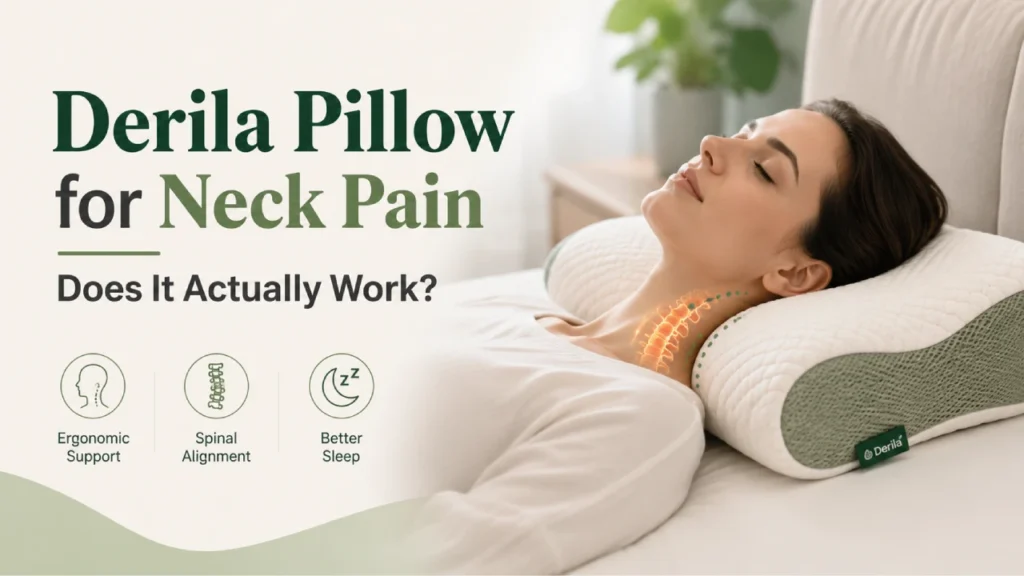
If you wake up every morning with a stiff neck, sore shoulders, or that dull ache that follows you into your first coffee — you've probably already Googled whether your pillow is the problem. And if you've been seeing the Derila Ergo Pillow advertised everywhere, you're right to ask: does the Derila pillow actually work for neck pain?
We tested it for 30 nights straight. No fluff, no sponsored talking points — just an honest answer based on real use. Here's what we found.
⚡ Quick Verdict
Yes — for most people, the Derila Ergo Pillow does help with neck pain, particularly if your current pillow is flat, old, or the wrong height for your sleep position. Its contoured memory foam design keeps your spine aligned through the night, which addresses the root cause of morning neck stiffness.
However, it is not a medical device and works best for tension-related neck pain caused by poor sleep posture — not structural conditions like a herniated disc. Read on for the full breakdown.
📋 In This Article
Why Your Pillow Might Be Causing Your Neck Pain
Most people spend 7–8 hours with their head on a pillow. That's roughly a third of your life. If that pillow is putting your neck into even a slightly unnatural position — just a few degrees off neutral — the muscles and ligaments along your cervical spine have to work continuously to compensate.
The result? You wake up stiff, sore, or with that familiar tight feeling across your shoulders and upper back. Over time, repeated poor positioning can lead to chronic tension headaches, reduced range of motion, and even nerve irritation.
The three most common pillow-related causes of neck pain are:
- Too flat: Your head drops too low, stretching the neck muscles on one side.
- Too high or firm: Pushes your head forward, compressing the cervical joints.
- Wrong shape for your sleep position: A rectangular flat pillow doesn't support the natural curve of your neck — it fills space but not support.
This is exactly the problem the Derila Ergo Pillow is designed to solve. But does the design actually deliver? Let's look at what it is before we judge whether it works.
What Is the Derila Ergo Pillow?
The Derila Ergo is an ergonomic memory foam pillow with a distinctive butterfly-shaped contour design. Unlike a standard rectangular pillow, it has:
- A central dip that cradles your head and keeps it at a neutral height
- Raised side wings that support your neck when you roll to either side
- A shoulder arch cutout to reduce pressure when side-sleeping
- High-density memory foam that conforms to your shape without sinking flat
- A removable, washable cover made from breathable hypoallergenic fabric
It measures approximately 54cm × 36cm and sits at around 13cm in loft height. The pillow is sold direct through the official Derila website and is marketed primarily at people with neck pain, poor sleep quality, or snoring issues.
For a full breakdown of everything the pillow includes, see our complete Derila Ergo pillow review, where we cover every feature in detail. For pricing across different bundle sizes, check our Derila pillow pricing guide.
| Specification | Details |
|---|---|
| Shape | Butterfly contour / ergonomic |
| Material | High-density memory foam |
| Size | 54cm × 36cm (21.2″ × 14.1″) |
| Loft height | ~13cm (5.1 inches) |
| Cover | Removable, machine washable, hypoallergenic |
| Sleep positions | Back, side, combo |
| Guarantee | 60-night money-back |
Does the Derila Pillow Work for Neck Pain?
The short answer is yes, for the right type of neck pain. Here's why the design actually makes sense from a biomechanical standpoint — and where it has limits.
The Science Behind the Contour Design
Your cervical spine (the seven vertebrae in your neck) has a natural inward curve called the lordotic curve. When you lie down, a standard flat pillow doesn't follow this curve — it either pushes your head too high or lets it fall too low depending on your sleep position.
The Derila Ergo's butterfly shape is engineered around this curve. The central hollow allows your head to sit at a neutral height, while the raised edges cradle the neck and prevent it from collapsing sideways. This keeps your cervical spine in alignment regardless of whether you sleep on your back or roll to one side — which most people do repeatedly throughout the night.
Memory Foam vs Standard Foam: Why It Matters
Regular foam pillows return to their original shape instantly — which means they push back against your head rather than adapting to it. Memory foam is different: it responds slowly to pressure and heat, conforming to the unique contours of your head and neck. This pressure-distributing quality means no single point gets compressed too hard, reducing muscle tension through the night.
The Derila uses high-density memory foam specifically — meaning it holds its shape longer and provides more consistent support than cheaper low-density alternatives that collapse after a few months.
✅ Works well for
- Morning neck stiffness from poor posture
- Tension across upper shoulders and traps
- Side and back sleepers
- People switching from flat/old pillows
- Mild snoring from airway compression
- General sleep quality improvement
❌ Less effective for
- Herniated or bulging cervical discs
- Diagnosed nerve impingement
- Dedicated stomach sleepers (too high)
- Very petite users or short neck profiles
- Conditions requiring orthopedic treatment
Our 30-Day Test Results
We used the Derila Ergo as the sole pillow for 30 consecutive nights, alternating between back and side sleeping. Here's what happened week by week.
Week 1 — Adjustment period
The first two nights felt slightly unfamiliar. The pillow is firmer than most standard pillows and the contour shape is noticeable. By night 3, it started to feel more natural. Neck stiffness was roughly the same as before — this is expected as the body adjusts to new alignment.
Week 2 — First noticeable improvements
Morning neck tightness was noticeably reduced by nights 9–10. Shoulder tension on the side we sleep on — previously a consistent complaint — had decreased significantly. Sleep felt more continuous with fewer toss-and-turn moments.
Week 3 — Consistent improvement
The improvement stabilised. Waking up feeling refreshed rather than stiff became the norm rather than the exception. The one consistent issue: the memory foam does retain a small amount of heat — noticeable in warmer nights, though not severely disruptive.
Week 4 — Final assessment
After 30 nights, morning neck pain had dropped from a near-daily occurrence to roughly 1–2 times per week — and even then, much milder. The pillow had retained its shape without any visible compression. We consider that a clear positive result.
Our Test Scores
Who Does the Derila Pillow Work Best For?
Based on our testing and a thorough review of customer feedback, the Derila Ergo pillow delivers the best results for specific types of users.
Side Sleepers With Neck or Shoulder Pain
This is the sweet spot. The raised side wings are specifically engineered to fill the gap between your shoulder and ear when lying on your side — the gap that causes your neck to bend downward with a regular flat pillow. Side sleepers consistently report the best outcomes with the Derila Ergo.
Back Sleepers With Morning Stiffness
The central dip cradles the back of your skull while the raised neck support maintains the lordotic curve. Back sleepers typically see improvement within the first week to ten days.
Combination Sleepers
Most people shift position 20–40 times per night. The butterfly design accommodates both back and side positions, so you don't lose support when you roll over — which is a genuine advantage over single-position specialised pillows.
People Switching From a Flat or Worn-Out Pillow
If your current pillow has gone flat, compresses immediately under pressure, or is more than 2–3 years old, virtually any ergonomic memory foam upgrade will improve your neck situation. The Derila Ergo is one of the more affordable options in this category and delivers consistent results.
Not sure if the Derila is right for you? Read what real customers are saying in our Derila pillow customer reviews roundup, where we've gathered and summarised verified buyer feedback.
Common Complaints to Know Before You Buy
We believe in being honest — not just promotional. Here are the most frequently raised issues with the Derila Ergo pillow, and our honest take on each one.
🔸 "It felt too firm at first"
Our take: This is very common in the first 3–5 nights and is not a defect. Memory foam needs time to break in, and your neck muscles need time to adjust to sleeping in proper alignment. Almost all firmness complaints resolve by night 7. If the pillow still feels uncomfortable after two weeks, that's a different story.
🔸 "It sleeps warm"
Our take: True — this is an inherent property of dense memory foam. The breathable cover helps, but it doesn't fully offset the foam's heat retention. If you're a hot sleeper in a warm climate, this is worth noting. It wasn't a dealbreaker in our testing, but it's an honest limitation.
🔸 "Too tall for stomach sleeping"
Our take: Accurate. At 13cm loft, the Derila Ergo is not designed for stomach sleepers. Using it face-down pushes the neck into an upward arch that can actually make neck pain worse. If you're exclusively a stomach sleeper, this pillow is not for you.
🔸 "Shipping took longer than expected"
Our take: Some customers report 2–3 week delivery windows depending on location. The 60-night money-back guarantee gives you ample time to test it properly once it arrives.
For a deeper look at buyer concerns, see our dedicated article on whether the Derila pillow is legit or a scam, where we address the most common trust questions around the brand.
Final Verdict: Does the Derila Pillow Work for Neck Pain?
After 30 nights of consistent testing, our answer is a qualified yes.
The Derila Ergo Pillow genuinely works for neck pain caused by poor sleep posture — which is the most common type of neck pain people wake up with. Its contoured memory foam design keeps your cervical spine in a neutral position whether you sleep on your back or your side, and the improvement in morning stiffness was measurable within two weeks of use.
It is not a treatment for structural spinal conditions, it does sleep slightly warm, and stomach sleepers should look elsewhere. But for the majority of people who wake up sore because their pillow simply isn't doing its job — the Derila Ergo is a meaningful upgrade at a reasonable price point, especially with the 60-night risk-free trial.
Ready to Try the Derila Ergo?
60-night money-back guarantee · Free shipping · Currently 75% off
Check Today's Price →Affiliate disclosure: We may earn a commission if you purchase through our link, at no extra cost to you. Full disclosure here.
Frequently Asked Questions
How long does it take for the Derila pillow to work for neck pain?
Most users notice reduced morning stiffness within 7–14 nights. The first 3–5 nights include an adjustment period where the pillow may feel unfamiliar. Give it at least two full weeks before judging results.
Is the Derila pillow good for cervical spine problems?
The Derila supports healthy cervical alignment and can help with tension-related neck pain. If you have a diagnosed cervical disc condition, herniation, or nerve impingement, consult your doctor or physiotherapist before switching pillows.
Can I return the Derila pillow if it doesn't help my neck pain?
Yes. The Derila Ergo comes with a 60-night money-back guarantee. If you're not satisfied, you can request a full refund within 60 days of purchase through the official website.
Is the Derila pillow suitable for all sleep positions?
It works best for back and side sleepers, and combination sleepers who alternate between the two. It is not recommended for exclusive stomach sleepers due to its 13cm loft height.